Continuous Footings
2011-09-21
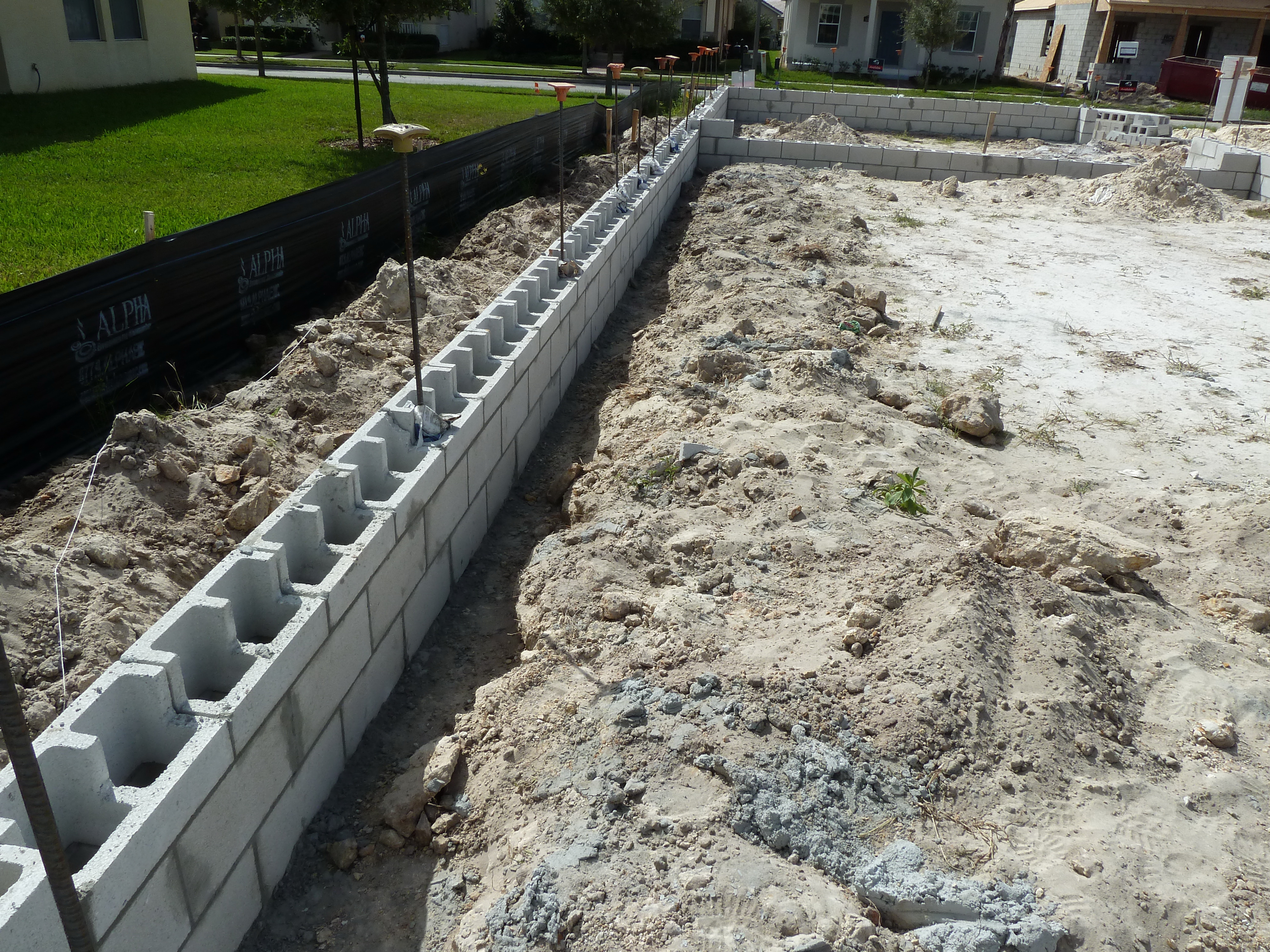
Continuous footings, also referred to as “strip” or “spread” footings, are concrete footings often used to support the load bearing walls in residential construction. This type of footing is shaped as a long rectangular box that is continuous below the supported wall, forming the base of an upside down “T”.
The size of residential continuous footings varies with the loading and soil conditions. However, a thickness range of 12” to 16” and width range of 24” to 30” are common. The area of soil or ground covered by the footing and the bearing capacity of the underlying soil determines the footing’s support capacity. Wider and sometimes thicker strip footings are required to support heavier loads.
Steel reinforcement is usually provided in strip footings and varies with the design loads and the local building code. The reinforcement typically consists of continuous or “longitudinal” steel bars placed near the bottom of the footing. They may also have shorter steel bars (the width of the footing minus several inches for concrete cover) placed, at regular intervals, perpendicular to and immediately above or below the longitudinal bars. These are sometimes referred to as “transverse” bars. The reinforcing steel provides additional strength and crack control.
Strip footings have a structural advantage over a monolithic footing. This advantage arises from the supported wall normally being centered over the footing. This reduces or eliminates eccentricity, or ‘off-center’ loading, which helps to reduce uneven soil bearing pressures and the potential for rotation or settlement.
A potential cost disadvantage of strip footings, as compared to monolithic footings, arises from the labor and materials associated with the forming and placing of concrete twice (once for the footings and once for the slab).
The supported wall is not always centered on the footing. An example where the wall is often placed off-center is a free-standing retaining wall. A retaining wall “retains” or holds back soil. These walls are often placed so that the footing and wall form an ‘L’. The weight of the retained soil (bearing on the bottom leg) restrains upward movement or overturning of the wall and buried footing, thus increasing its ability to "retain". The soil weight also reduces the likelihood that the footing will move or slide horizontally by increasing the frictional force between the soil and the bottom of the footing.
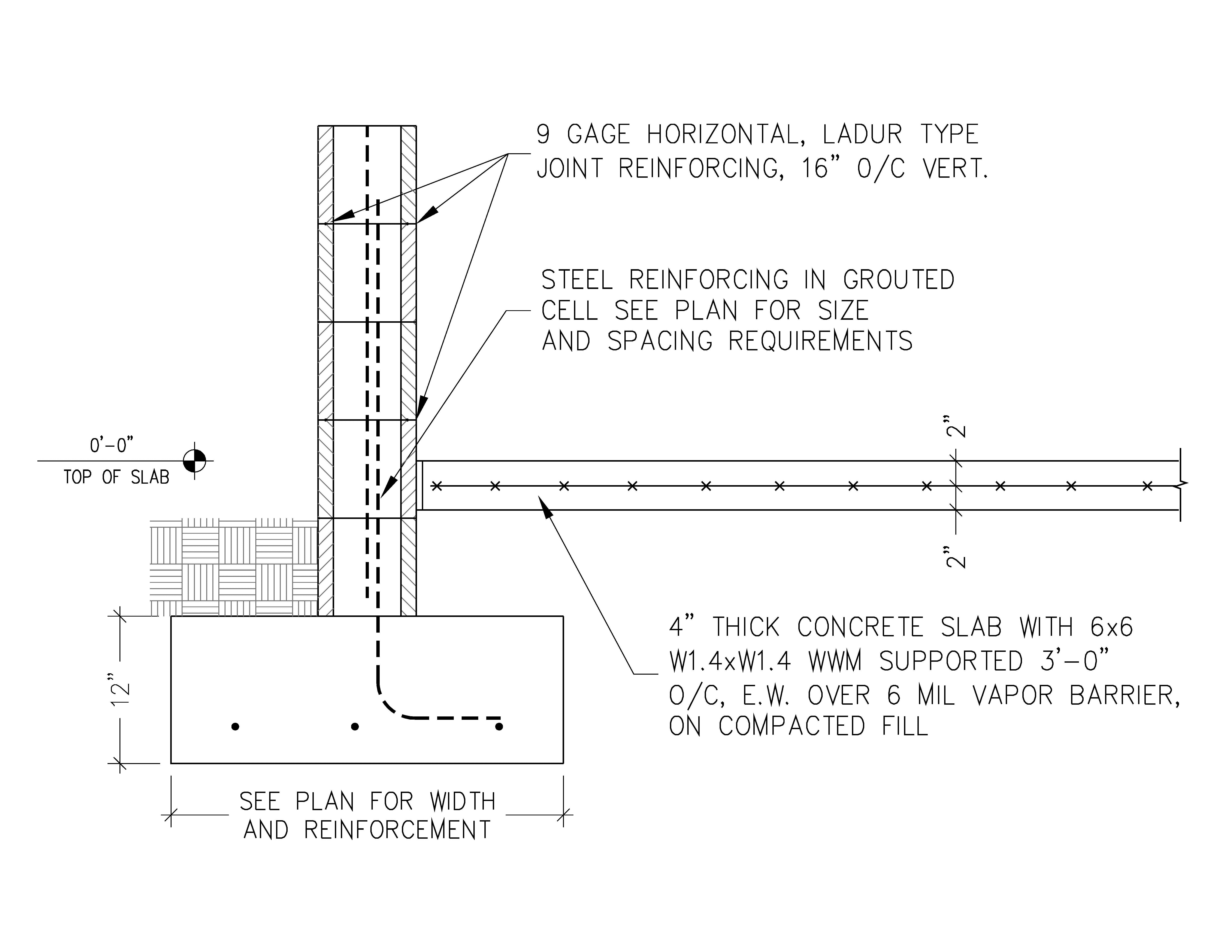
The following sketch is an example of a concrete strip footing supporting a typical CMU residential exterior wall. The slab on grade shown is sometimes referred to as a "floating slab" as it is not structurally connected to the wall. Alternatively, the slab may be placed over the CMU, and the wall started again on top of the slab edge: