Isolated Footings
2011-09-16
Isolated footings, or “pads”, are isolated from other footings and are typically used for the support of load bearing posts or columns. They are often placed outside the main structure, such as to support a roof overhang, but are also commonly located at the interior for the support of post or columns point loads. In residential slab on grade construction, they may be placed with the slab (monolithically), or prior to (underneath) the main slab concrete. Isolated footings are generally square or rectangular in shape.
The length and width of isolated footings varies with the load they are intended to support. The weight of the supported vertical load combined with the weight of the footing itself is divided by the total area of the footing. This computation approximates an applied pressure, which must be less than the bearing capacity of the soil.
In residential construction, the thickness of an isolated footing generally varies between 12” and 24”. For heavier point loads, a thicker footing may be required to avoid a shear or punching failure of the concrete. If the supported column or post is expected to experience uplift, then the connection of the column to the footing must be adequate. Uplift conditions also require that the footing (and overlying slab) be large and heavy enough to prevent upward movement, if other uplift restraint provisions are not made.
Steel reinforcement is usually provided in isolated footings and varies with the design loads and building code in effect. The reinforcement typically consists of a grid of reinforcement steel bars placed near the bottom of the footing. With heavier point loads or large footings, another steel grid may be required near the top of the footing. J bolts intended to anchor the column or post base plate to the footing are sometimes pre-set with a template and cast into the concrete, to avoid drilling holes in the concrete later.
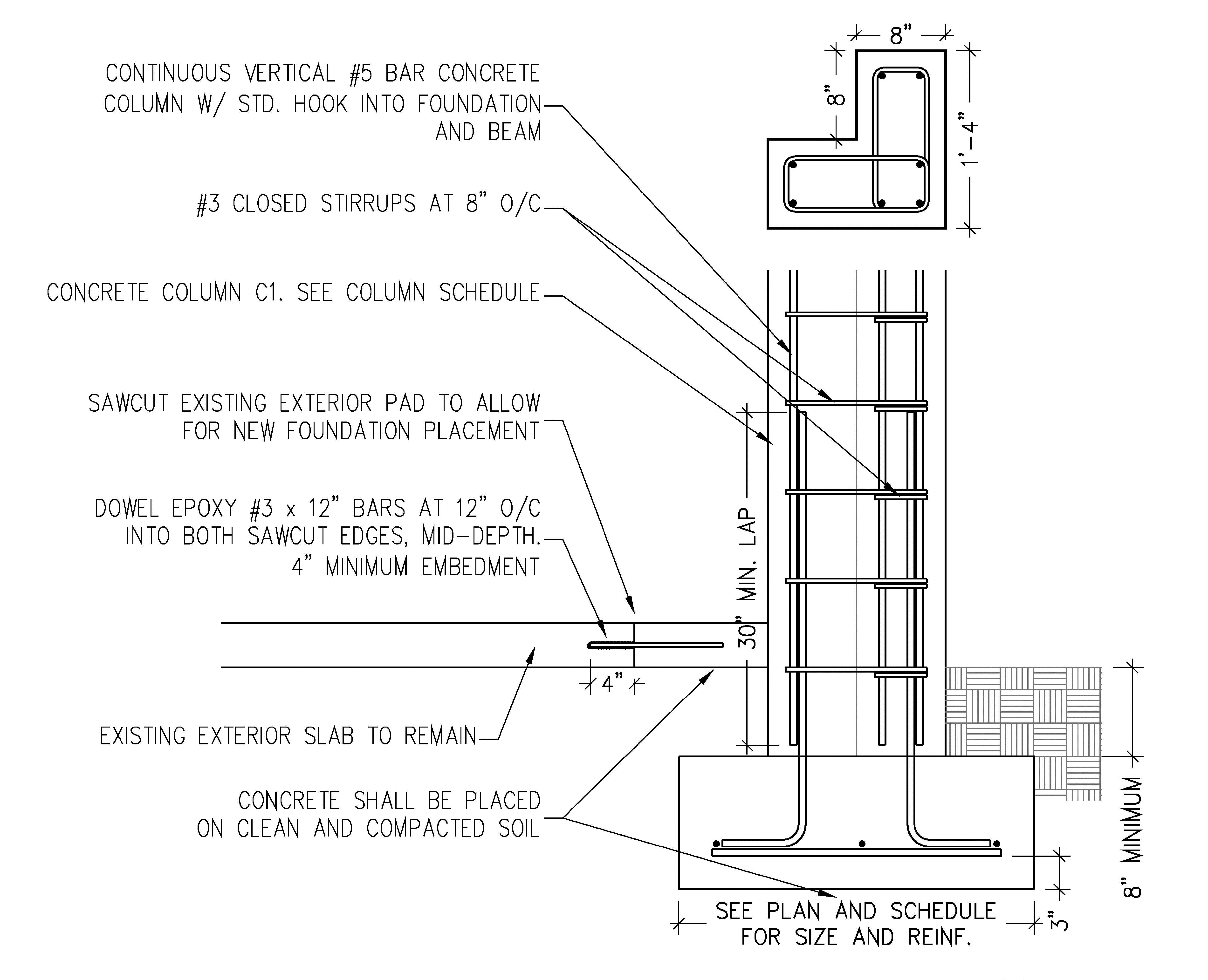
The following is an example sketch of an reinforced concrete isolated footing. In this case, the footing supports a new 'L' shaped reinforced concrete column at the exterior of an existing home. Alternatively, an isolated footing may support a steel, wood, or CMU column: