Wood Framed Load Bearing Walls
2011-10-05
Wood framed load bearing walls (sometimes referred to as 'stick framed') are common in residential construction. Many homes are constructed entirely of wood framed walls at both the interior and exterior. 2x sawn lumber is most commonly used for wood framed walls. While wood framing varies with the specific structure and need, all framed walls have the same basic components. There are several advantages and disadvantages when comparing wood framed walls to CMU block walls.
For a given wood framed wall, all members typically have the same cross sectional. For example, a 2x6 wall will normally have a 2x6 bottom plate, 2x6 studs, 2x6 top plate, 2x6 sills, etc. Most modern wood framed homes are constructed with 2x4 or 2x6 inch nominal standard dressed lumber. The actual size of these members is 1-1/2 x 3-1/2 and 1-1/2 x 5-1/2 inches, respectively.
The basic components of a wood framed wall are the bottom plate, the vertical members (studs) placed at regular intervals, the top plate, connectors, and (in the case of exterior walls) sheathing. Walls also have such members as cripples, headers, and sills which are used to provide openings in the wall.
The bottom plate typically consists of one single pressure treated member that is bolted, pinned, strapped, or nailed to the slab, foundation, floor, or beam which supports it. Pressure treated wood should be used for the bottom plate if it is in contact with concrete or masonry, or otherwise likely to be exposed to adverse conditions such as high moisture. The bottom plate effectively acts as blocking with regards to gravity loads in the studs. In other words, the studs transfer weight directly through the bottom plate into the structure beneath. Sheathing may also transfer gravity loads to the bottom plate. The connections between the bottom plate and the supporting structure may also be subjected to uplift or shear forces.
The studs are vertical members spaced at regular intervals that typically vary between 12 and 24 inches. The spacing between the studs may vary with the expected loads on the wall, the height of the wall, and the species and grade of the wood used. In areas subjected to significant wind loads, the stud connection to both the top and bottom plate should be sufficient for a continuous load path from the top plate to the foundation. An example of this type connection would be a flat steel strap bent into a U-shaped connector that is placed over the plate at the studs, and nailed to both side of the stud.
The top plate of a load bearing wood framed wall consists of two horizontal members secured to the top of the studs. The top member of the top plate laps over perpendicular intersecting walls. The top plate members should lap over each other at joints so as to provide a continuous tensile load path, which may occur due to diaphragm action. The top plate also transfers gravity and uplift loads to the studs below.
Walls are either prefabricated elsewhere and delivered, or hand framed on site. When constructed on site, they are generally assembled on a floor, slab, or other flat horizontal surface. The top and bottom plates are placed together, marked, then separated (still parallel) the length of the studs. The studs are crowned and put into place along with the headers, cripples, sills, and other framed members associated with wall openings. The entire assembly is then fastened together, often with 16d common nails and whatever additional connectors are required. In the case of exterior walls, the sheathing is installed either before or after the wall is lifted and fastened in place.
The species and grade of the wood used in load bearing walls varies, but Southern Yellow Pine #2 may be the most common. Different species and grades may be chosen based on their availability, price, strength, moisture resistance, or aesthetics. Some species such as Cedar and Cypress are naturally decay resistant.
There are advantages and disadvantages of wood framing compared to CMU block walls. One of the most significant advantages is thermal insulation. The cavities between the studs allow fiberglass or other efficient insulation. Wood framed walls are lighter than CMU. This fact may allow smaller footings, but require greater attention to wind uplift forces. Wood framing is generally considered less expensive than CMU, but this depends upon local availability and cost of materials and labor. Framed walls are more flexible than CMU, may therefore may be less susceptible to cracking from settlement. However, stucco over wood framed walls is susceptible to cracking due to swelling of the wood. Probably the most significant disadvantage of wood framing is its susceptibility to rot and insect damage.
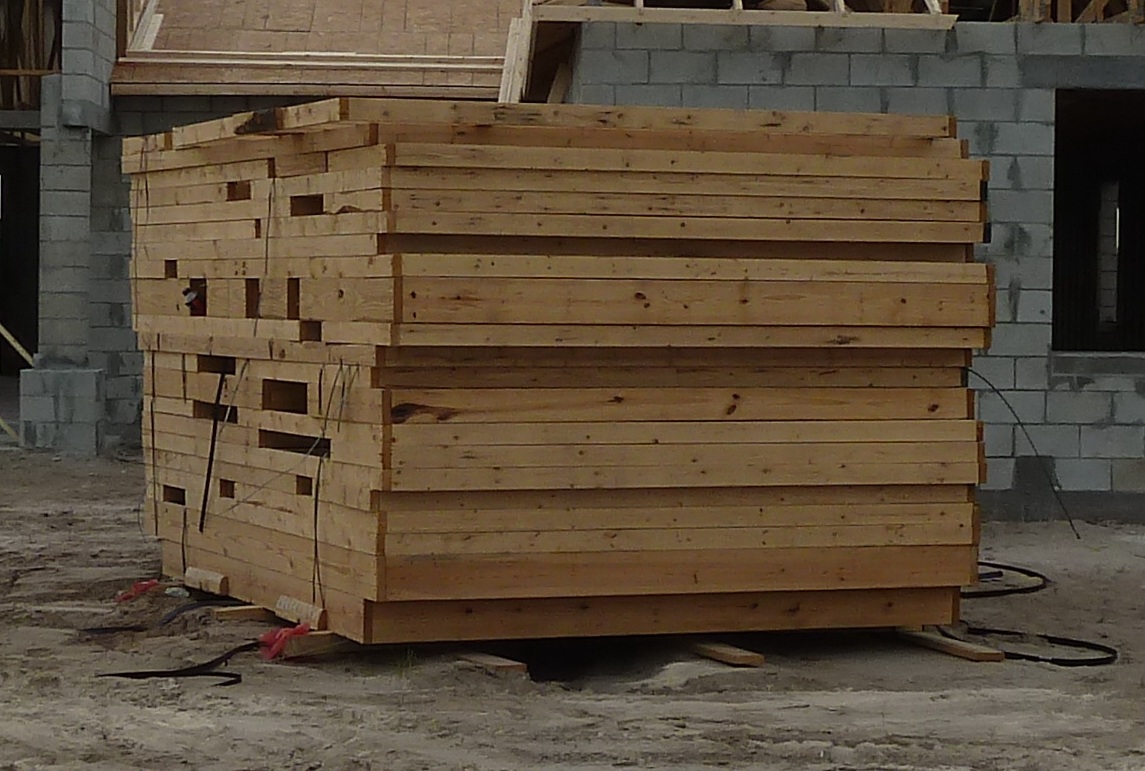
The following photograph shows a stack of prefabricated wood framed walls delivered to a jobsite: