Piles and Grade Beams
2011-09-16
Piles can be thought of long and slender structural members (or columns) placed in the ground below the supported structure. Sheet piles are not considered here. Piles are often used in residential construction where the bearing capacity of the surface soil is poor. They are made of concrete, steel, timber, or a combination of these. They may be driven, vibrated, drilled or pounded into the soil. Drilled piers or auger-cast piles may be grouted or cast in place. Drilled piers consist of a hole drilled in the ground and filled with grout. When the water table or loose soils are present, auger cast piles may use a drill bit to pressure inject grout as the bit is slowly removed. A cylindrical steel reinforcement 'cage' is often used to reinforce concrete piles.
Piles may support loads directly or be used to compact soil intended to support construction. Piles that support vertical loads directly support those loads primarily through end bearing and friction. End bearing piles rest directly on a stronger soil or rock layer. The bottom of a drilled pier is sometimes flared out to increase its end bearing capacity. Friction piles rely on the friction between the side of the pile and the surrounding soil. A pile may rely on both mechanisms of support. The soil surrounding the length of the pile also acts as a horizontal brace which prevents buckling of the pile.
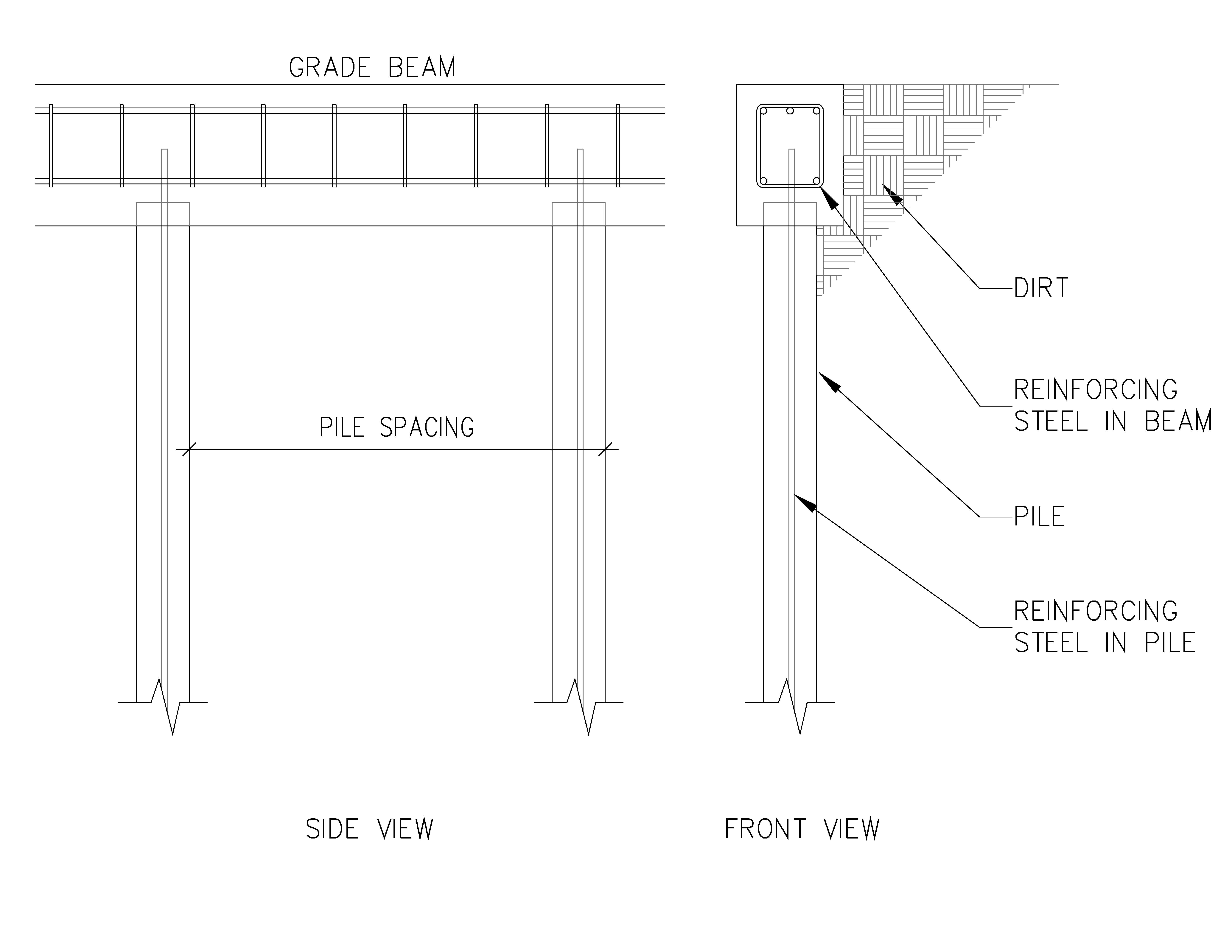
In residential construction, piles are often used to directly support grade beams. Concrete grade beams span between the tops of the supporting piles at or just below ground level. In expansive soils, or clay, the bottom of the grade beam is generally isolated from the soil to prevent upheaval damage to the beam. In cohesionless soils, or sand, the beams are generally placed directly on the soil. Grade beams are provided with top and bottom continuous reinforcement steel and stirrups. The grade beams support load bearing walls and columns, and the first floor structure, excluding concrete slabs on grade. The first floor structure may be wood framed, placed as a structural concrete slab (requiring no soil support) or as a slab (bearing) on grade.
The tops of several piles placed close together are sometimes covered with a pile cap. Pile caps are square or rectangular concrete pads. One or more columns are erected over the top of the pile cap. A pile cap is similar in shape to an isolated footing, but different in that the load on the cap is distributed to piles rather than to soil below the pile cap. Pile caps are often used for heavier commercial or multi-unit residential construction. They are not often used for typical single family home construction.
The following is a simple sketch of a grade beam supported by piles spaced at intervals:
 ADDITIONAL RESOURCES:
ACI 318 - Building Code Requirements for Structural Concrete
ACI 543R - Design, Manufacture, and Installation of Concrete Piles
Timber Pile Design and Construction Manual
AWPA Standards