Framed Wood Floor Structure
2011-09-19
Sawn or engineered lumber joists are often used (in lieu of trusses) to frame residential floors. The structure of a typical wood framed floor typically involves three primary structural components. The first of these is the subfloor decking (or sheathing). The term "subfloor" refers to the structure beneath the finished, exposed flooring. The decking spans across and is supported by the floor joists. It is sometimes visible when finished flooring (such as vinyl or carpet) is pulled up. The second primary component of a hand framed floor structure is the floor joists. Floor joists are spaced at regular intervals and are typically sawn or engineered lumber. In some floor structures, beams support the floor joists and if existing, could be considered the third primary component of a floor structure. Finally, the beams and or joists are supported by load bearing walls and or columns. Columns are often used to support heavy gravity loads carried by beams. A properly designed, constructed, installed, and protected hand framed wood floor structure whose load bearing capacity is not exceeded will serve the life of a home. Problems may arise if any of these conditions are not met.
Floor decking typically consists of sheathing (plywood or orientated strand board (OSB)) or wood boards. The decking spans over the floor joists, and therefore must be of sufficient strength and stiffness to transfer any point load to the adjacent floor joists without failure or excessive deflection. Wider floor joist spacing requires thicker and stronger floor decking. The thickness of plywood or OSB sheathing varies with the type and application, but 3/4" is common for floor decking. Wood planks (boards), 1-1/2” thick, are also commonly used for floor decking. The width of the individual planks is significant with regards to point loads. When loads are applied over an area, 2x4 decking is as capable as 2x6 or 2x8 decking. However, if a point load happens to be applied to only one board, then a wider board is obviously stronger than a narrow board. This concept is not as significant if adjacent floor planks interlock with each other by a tongue and groove mechanism. This has several advantages: point loads are transferred to adjacent boards and movement is restrained across the boards, resulting in a quieter, tighter, and smoother floor.
The floor joists provide support to the floor decking or planks. The joist type, size, grade, and spacing is determined by their unsupported length (span), the support conditions, and loading conditions. Floor joists are supported by beams or load bearing walls. The beams may be composed of sawn lumber, LVLs, reinforced concrete, CMU, or structural steel. The floor joists may bear on the top, or be attached to the side of a beam. The beam capacity is determined by its unsupported length, or span, and the tributary area of the floor joists it supports. A typical floor beam is supported by a load bearing walls or columns. The load bearing walls may be exterior (perimeter) walls, or located at the interior. Walls and columns are supported by foundations or other structural components.
When compared with a wood trusses, a hand framed floor structure may have an advantage in that sawn lumber is readily available at a lumber yard, where trusses generally need to be pre-ordered. Also, they are usually less deep, and thus use less vertical space within the home. However, it is more difficult to place utility lines, such as electric wires, heating ducts, and plumbing in a hand framed floor structure. This is because trusses have spaces between the webs and chords which allow placement of utility lines.
Finish flooring such as carpet, tile, or vinyl is applied to and supported by the floor decking or sheathing. The finish flooring generally has no structural support value and is not considered to be a part of the ‘floor structure’. However, it can be affected by a problem with the floor structure, and vice versa.
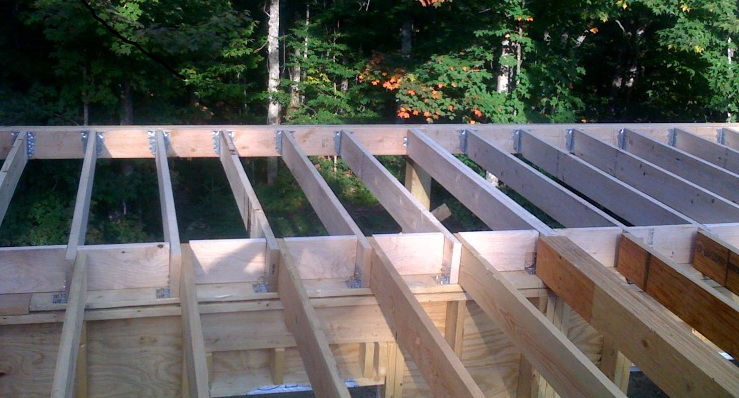
The following is a photograph of a framed floor structure under construction. Standard dressed 2x8 sawn lumber and LVLs were used for the joists. The LVLs are visible at the lower right hand corner, including a triple ply beam intended to support a load bearing interior wall (not shown). The rear joists are secured to the face of the triple 2x8 beam (at rear) with metal connectors and are supported at the other end by the rear 2x6 framed exterior wall. The interior joists are also supported by the rear exterior wall, and blocking exists between the end-to-end joists: